
By: Sanad Sahelia
Christmas in Palestine is not a seasonal festivity or a national event placed on the public calendar. It is a profound ecclesial mystery that proclaims the presence of God Incarnate in this land, where divinity united with humanity and the history of salvation began in Bethlehem. It is a salvific moment that illuminates the sanctity of both humanity and place. Here, Christmas is a living testimony of faith renewed in the heart of Palestinian suffering—an embodiment of our identity and heritage expressed in liturgy and prayer, as well as in streets and public squares.
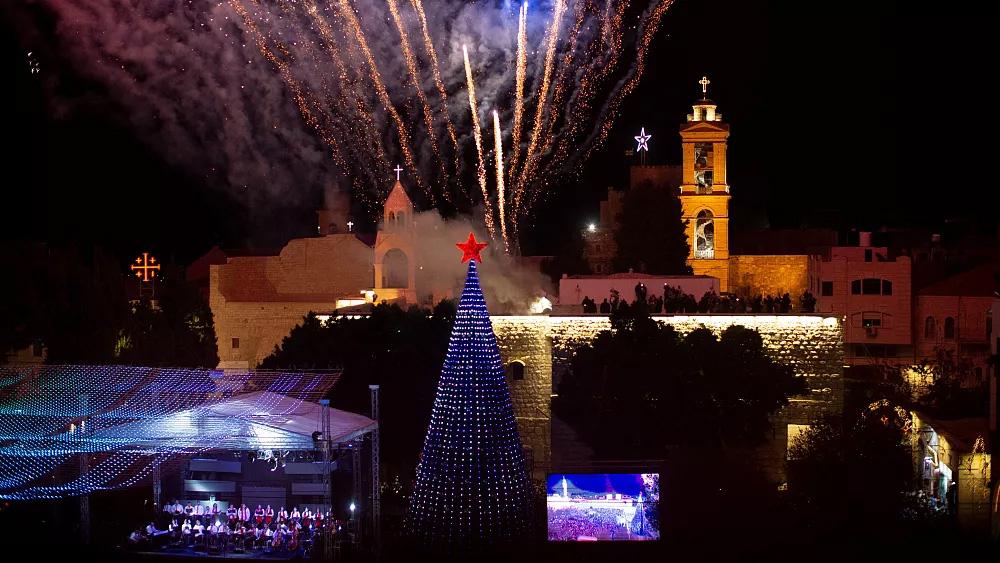
Within this understanding, the popular traditions surrounding Christmas become an extension of faith itself. The lighting of the tree, scout parades, carols, and communal celebrations are not decorative activities but living expressions of the spiritual meaning of the feast. Like “a tree planted by streams of water,” with roots anchored deep in the rock of this land, our Christian identity in Palestine stands firm despite all storms. Every carol sung, every tree illuminated, and every parade that marches is a declaration of faith and steadfastness, affirming that Palestinian Christians remain here—guardians of holiness and witnesses of hope in their sacred homeland.
Disregarding this heritage or belittling its significance is not a minor issue; it is a direct challenge to our historical roots. Every step that weakens the presence of Christmas or strips it of its meaning—including its popular manifestations—contributes, even unintentionally, to an ongoing effort to erase our identity and obliterate our history and heritage in the Holy Land. This, in effect, aligns with the forces seeking to negate our presence and our historical rights. Here emerges the central question: How do we preserve the feast as a sacred ecclesial celebration while acknowledging its national and social significance, without compromising its spiritual essence or its authentic Christian identity?
Between Holiness and Nationhood
In Palestine, annual debates intensify over how Christmas should be celebrated, especially in moments of political or security tension. The core question remains: Is Christmas a sacred ecclesial feast, or a national occasion to be treated as a public event? Undeniably, Christmas in Palestine carries a unifying national dimension. It presents Palestine to the world in its cultural and religious diversity, strengthening its historical, social, and touristic presence.
Yet the confusion between the ecclesial and the national is not merely a matter of terminology; it touches the core of faith and identity and poses a genuine risk when Christmas is reduced to a purely civil celebration. In our land, where religion and politics often intersect, the line between worship and official public events can at times become blurred. Even the Christmas Mass is sometimes viewed as a protocol occasion within the calendar of official ceremonies, rather than the spiritual center that directly connects believers to the mystery of the Incarnation.
Is the contradiction not evident? Those who once regarded participation in public, economic, or cultural events—as well as musical, artistic, and sports festivals—as acts of resilience and identity preservation, now argue that Christmas events, which reflect our social and cultural heritage, are unsuitable or contrary to the concept of steadfastness. Here, the link between the sacred and the national becomes clear: popular Christmas symbols become a living test of our commitment to faith and identity amid harsh political and social realities.
Popular celebrations are not fleeting moments of joy; they are a cry of life and presence: we are here, holding fast to our faith, rooted in our heritage, and convinced of our right to our land and our identity. Preserving this heritage is not a luxury; it is a national and religious duty, a vital tool in resisting marginalization, cultural erasure, and distortion of our identity in Palestine and across the Levant. Thus, every element of celebration becomes a link between personal faith, collective heritage, and national belonging—affirming that safeguarding religious and social identity is an integral part of our steadfastness.
Defining the Meaning of the Feast
Words are not mere descriptions; they shape our understanding of the feast and frame its identity. When Christmas is labeled a “national holiday,” it risks becoming an administrative matter subject to political and situational considerations. When it is affirmed as a “sacred ecclesial feast,” its bond with faith, worship, and identity becomes clear, and its meaning cannot be reduced or stripped of its sacred symbolism. Christians must therefore use these terms carefully and precisely, ensuring that the meaning of Christmas is not lost—as many spiritual values have been lost in the noise of politics and administration.
Christmas is not simply a celebration. It is a proclamation of living faith and identity, a message of salvation, and a vivid expression of the holiness of place and time. Preserving its sanctity—alongside its traditional popular expressions—is a religious, national, and moral responsibility, and a manifestation of resilience in the face of cultural, historical, and political erasure.